Yesterday we got the results of the local elections, which took place on Thursday. On the day of voting I was busy playing space-themed mini golf with my son, whose school was closed for the day because it’s the local polling station.
This always infuriates me: partly because I have to take a day off work (or risk parking the kid in front of a TV all day while I try to attend meetings), and partly because it’s asking a hundred local children to lose a day of education so that—if we’re lucky—40% of the eligible local voters actually show up and participate in democracy.
But this time they did turn out: our local, longstanding Labour candidate lost by a couple of hundred votes to the Green insurgency. I felt for her: she’s been very visible locally for a long time, and made things happen when we needed her. But I also suspect that voting Labour in 2026 is a very difficult ask, even for former party loyalists.
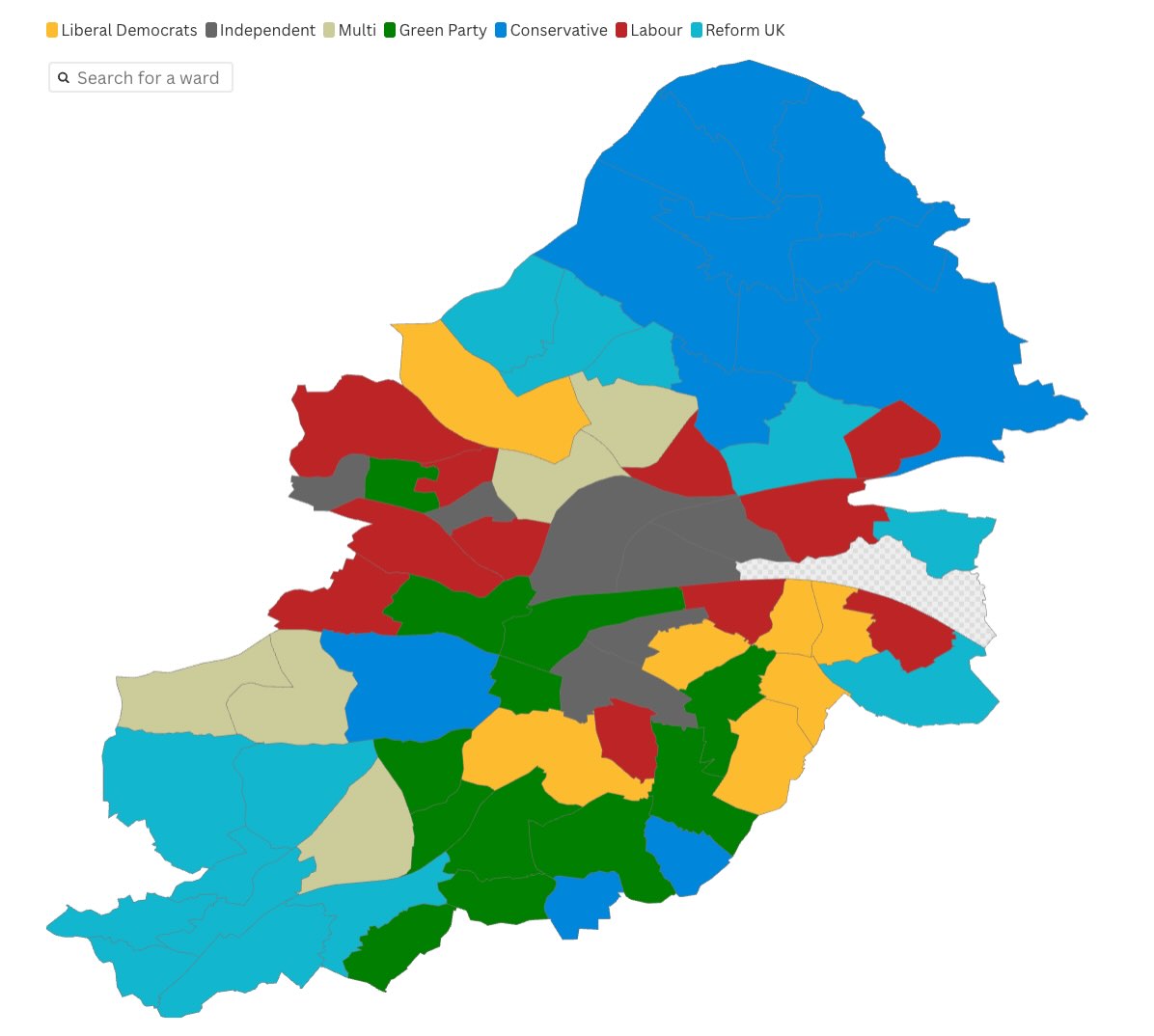
Birmingham, where I live, is now in the unique position of “no overall control” – the council website shows a beautiful patchwork map of local wards and their results. No single party has a majority, and Birmingham council is one of the largest in Europe. Nobody really knows how this is going to unfold, and how a piecemeal collective of distrustful opponents will govern this troubled region.
There’s nothing I can do to fix it and it feels like the problem faced by the entire country (or indeed the world) in microcosm. I’ve never felt less engaged—or less hopeful—about politics and society in my life. Something has to change: this is the only thing I agree on with the Reform party. But it’s not clear what appetite there truly is for it.
Reading this week
1. The devout Muslim making a living from Islamophobic AI slop (The Bureau of Investigative Journalism)
“This man, who we are not naming for his own safety, runs successful accounts pushing Islamophobic AI slop to UK audiences. Videos shared by just one of his Facebook pages had been viewed millions of times and he told us in an interview he earned around $1,500 a month from that page alone.”
A depressing read (sorry) about the inevitably end state of cheap AI content generation tools, Facebook’s algorithmic harms and the temptation for people in developing countries to participate in weaponised hate, because it pays the bills.
2. Google Chrome silently installs a 4 GB AI model on your device without consent (That Privacy Guy)
“Google Chrome is reaching into users’ machines and writing a 4 GB on-device AI model file to disk without asking. […] At Chrome’s scale, the climate bill for one model push, paid in atmospheric CO2 by the entire planet, is between six thousand and sixty thousand tonnes of CO2-equivalent emissions.”
This is interesting because it’s annoyed a whole bunch of folks: from the privacy crowd, the environmental activists, and also the tech crew who are opposed to Google’s continued dominance of the “open” web. Maybe it will help people start to realise that Chrome didn’t save the web, it just made it easier for Google to become the default (RIP AMP, not).
3. Meta Is Dying. It’s About Time. (Julia Angwin, NYT)
We will all get to watch Mr. Zuckerberg drive the company into the ground. From 2021 to 2026, he poured $80 billion into the Metaverse in the firm belief that we would all want to don headsets and hang out in a virtual world populated by legless avatars. Even after shutting that project down, the company still loses billions a quarter on projects like selling $500 “smart” glasses that are not only unpopular but also give major creep-filming-you-without-consent vibes.
A good piece which sparks hope that Facebook’s relentless pursuit of your data and privacy may have an (eventual) end date as younger users abandon it, and its continuous pivots begin to suggest fatigue. Also—hilariously—this piece has been attacked on BlueSky, of all places, by some senior comms bloke from Facebook.
4. What Will It Take to Get A.I. Out of Schools? (Jessica Winter, The New Yorker)
L.L.M.s encourage cognitive offloading before kids have done much cognitive onloading—that is, if these tools cause atrophy of thought in adults, then we can scarcely overestimate the potential effects on a brain that has not developed those cognitive muscles in the first place.
A subject close to my heart: I’m concerned about how quickly and easily people have moved over to treating LLMs like knowledge engines, asking them to plan holidays and lookup information for them. I use these tools all the time at work (to generate summaries, to combine multiple status reports into one, to digest complex requirements) but I baulk at the idea of using them to create something from nothing.
Thankfully, my seven year old son came home from a school assembly about AI where he’d been specifically taught that AI often steals or makes things up. I was glad that his school had led with caution and risks, rather than the much easier/attractive proposition that it can do all kinds of fun and clever things without any insight into how it “knows” how to do them.
Fun and miscellany this week
1. Listen to the cool noise this speed square makes when thrown (@lostcoastedc on TikTok)
Some guy discovered that hurling a metal carpenter’s tool at trees makes an incredibly cool noise when it bounces back at you.
2. Tolkien’s letter on what makes art live on inside your head (Aura/Moom)
I am doubtful myself about the undertaking. Part of the attraction of the L.R. is, I think, due to the glimpses of a large history in the background: an attraction like that of viewing far off an unvisited island, or seeing the towers of a distant city gleaming in a sunlit mist. To go there is to destroy the magic, unless new unattainable vistas are again revealed.
Having just finished reading the Narnia books with my son, I’m in full agreement here. The best follow-up discussions with my kid are when he asks “but what about ____?” and I get to say “nobody knows – what do _you think happened?”